
2009 Call for Papers

July 15th, 2008

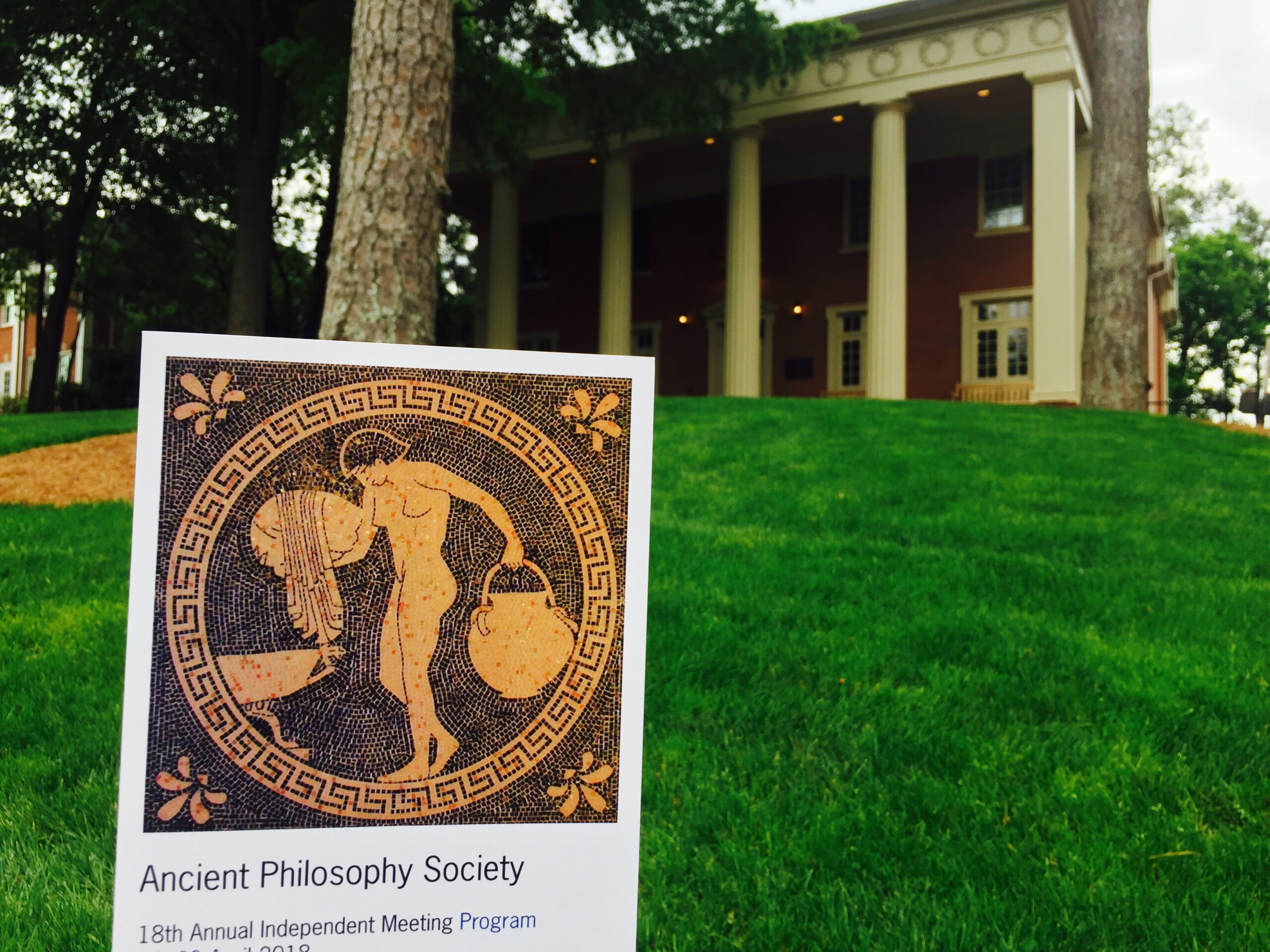
Download the pdf of the 2009 Call for PapersThe Ninth Annual Independent meeting of the Ancient Philosophy Society will be held in Baltimore, Maryland at Loyola College in Maryland and take place at the Graduate Center Timonium Campus from April 23-26, 2009.

Papers on any topic in ancient Greek and Roman philosophy are invited. Papers should be no more than 3000 words, 30 minutes reading time. Panel proposals will be considered, though they should be as complete as possible. Please prepare papers for blind review, with personal information on a cover sheet. Abstracts will not be considered.

Submission Deadline:
November 30, 2008

Inquiries and submissions (four paper copies plus one electronic copy, prepared for blind review) should be directed to:

Gary Scott
Department of Philosophy
Loyola College in Maryland
4501 North Charles Street
Baltimore, MD 21210

For electronic submissions or inquiries use only this email address:
submissions@ancientphilosophysociety.org

The 2009 Call for Papers is available for download in pdf format, we encourage you to print and post it in locations where interested people might view it.

Journal of the History of Philosophy

September 22nd, 2008

Tad Schmalz, editor of the Journal of the History of Philosophy, requested that we post the following letter to encourage scholars in ancient philosophy to submit to the JHP.

Dear colleague:

I write in my role as Editor of the Journal of the History of Philosophy to draw the attention of scholars and students of ancient philosophy (including the philosophy of late antiquity) to JHP. The Journal has an established tradition of publishing excellent peer-reviewed articles, notes, reviews and discussions across the breadth of the Western philosophical tradition. This work has included seminal articles on ancient philosophy. Though there are of course several reputable journals that specialize in ancient philosophy, publication in JHP allows authors to reach not only specialists but also a more general audience that includes those who do not work primarily in this area but who find scholarship on ancient thought to be valuable.

Recent JHP articles on ancient philosophy include:

  • Christine Thomas, “Inquiry Without Names in Plato’s Cratylus
  • Richard Foley, “Plato’s Undividable Line: Contradiction and Method in Republic VI”
  • Hye-Kyung Kim, “Metaphysics H 6 and the Problem of Unity”
  • Jean De Groot, “Dunamis and the Science of Mechanics: Aristotle on Animal Motion”
  • Mark L. McPherran, “Socratic Epagôgê and Socratic Induction”
  • Miriam Byrd, “The Summoner Approach: A New Method of Plato Interpretation”
  • Thornton Lockwood, “Is Natural Slavery Beneficial?”
  • Glenn Rawson, “Platonic Recollection and Mental Pregnancy”
  • Pauliina Remes, “Plotinus’s Ethics of Disinterested Interest”
  • Lloyd P. Gerson, “What is Platonism?”

JHP also has a special Current Scholarship series, which comprises invited critical reviews by senior scholars of the recent literature on various figures or topics in the history of philosophy. Recent and forthcoming contributions to this series that pertain to ancient philosophy include:

  • Mary Louise Gill, “Aristotle’s Metaphysics Reconsidered” (July 2005)
  • Jan Opsomer on Late Ancient Philosophy (forthcoming)
  • Patricia Curd on Presocratic Philosophy (forthcoming)
  • Francesco Fronterotta on Plato’s Republic (forthcoming)

The Journal prides itself on a quick turn-around from submission to decision; in 2007–08, the average time between initial submission and final decision for manuscripts reviewed externally was just 68 days. The average time between final acceptance and publication is now approximately one year. For further information about JHP, please visit our online site at http://philosophy.duke.edu/jhp/.

I hope that you and your students will keep JHP in mind when considering an apropriate venue for your articles on ancient philosophy.  Please feel free to contact me at jhpeditor@duke.edu if you have any questions concerning the Journal.

Sincerely,

Tad M. Schmaltz

Editor, Journal of the History of Philosophy

Job: UNC Charlotte

September 16th, 2008

Below is a job announcement from UNC Charlotte.  They asked that I post this here and encourage our members to consider applying.  It seems that they are open to someone who has been out a few years or even someone who has been recently tenured.  The announcement below is also found in Jobs for Philosophers.

40, *41. UNIVERSITY OF NORTH CAROLINA, CHARLOTTE, NC The Philosophy Department invites applications for an Assistant/Associate Professor, beginning August 2009. The area of specialization is open, but we have particular needs in Ancient Philosophy, Ethics/Applied Ethics, non-Western philosophy, or some combination of these areas. Teaching load: two courses per semester, undergraduate and graduate. Teaching experience appropriate to rank; Ph.D. required; publication appropriate to rank. Research and service interests that enhance our ability to pursue external grants are desirable.

UNC Charlotte is a rapidly growing doctoral-level state university located in a thriving urban area with a student body of more than 22,000 and a full-time faculty of over 750. The department currently has 13 full-time and 7 part-time faculty, including two Distinguished Professors. We offer a traditional and applied major, a Graduate Certificate in Applied Ethics, and an M.A. in Ethics and Applied Philosophy. Our M.A. is linked to a number of interdisciplinary Ph.D. programs on campus and we provide research ethics courses for many of them. So we have a strong tradition of interdisciplinary studies involving all seven of the University’s colleges. We are closely affiliated with UNC Charlotte’s Center for Professional and Applied Ethics, where the successful candidate is expected to be an active faculty associate.

Please visit our web site: www.philosophy.uncc.edu. Please submit electronically only a letter describing your qualifications, CV, and writing sample as attachments on the following UNC Charlotte website: https://jobs.uncc.edu. A transcript and three letters of recommendation should be sent through regular mail to: Michael Kelly, Chair, Department of Philosophy, University of North Carolina at Charlotte, 9201 University City Boulevard, Charlotte, NC 28223. Screening of electronic applications will begin immediately and continue until the position is filled. We may be interviewing at the 2008-2009 APA Meetings. UNC Charlotte is an AA/EOE employer, values diversity in its faculty and students, and strongly encourages applications from women and underrepresented minorities.

Plato and the Question of Beauty

July 16th, 2008

Drew Hylands Plato and the Question of BeautyAnnouncing the publication of Drew Hyland’s Plato and the Question of Beauty.

The publisher’s description of the book reads as follows:

“A well written and forcefully argued exposition of one of the most important themes in Plato’s philosophy.” —Walter Brogan, Villanova University

Drew A. Hyland, one of Continental philosophy’s keenest interpreters of Plato, takes up the question of beauty in three Platonic dialogues, the Hippias Major, Symposium, and Phaedrus. What Plato meant by beauty is not easily characterized, and Hyland’s close readings show that Plato ultimately gives up on the possibility of a definition. Plato’s failure, however, tells us something important about beauty—that it cannot be reduced to logos.

Exploring questions surrounding love, memory, and ideal form, Hyland draws out the connections between beauty, the possibility of philosophy, and philosophical living. This new reading of Plato provides a serious investigation into the meaning of beauty and places it at the very heart of philosophy.

http://www.iupress.indiana.edu/catalog/product_info.php?products_id=76819

Studies in Continental Thought
168 pages
978-0-253-35138-8, cloth $55.00
978-0-253-21977-0, paper $21.95

Membership Fee Increase

July 12th, 2008

Due to increasing costs of administering the society, the Executive Committee has agreed to raise the regular membership fee from $50 to $60 and the graduate student membership fee from $25 to $30.  This slight increase is designed to offset some of the costs we have incurred since the Philosophy Documentation Center has started providing very valuable and important services of administering our membership and annual conference registrations.

Although unfortunate, we think increasing the membership fee this small amount is in the best interest of the long term health and strength of the society.

International Plato Society

July 7th, 2008

One of our members, Debra Nails, who will be co-hosting our annual meeting at Michigan State in the spring of 2010, is also involved with the International Plato Society. Some of our members might be interested in this society whose description is as follows:

Founded in 1989, the International Plato Society promotes Platonic studies throughout the world and communication among scholars of diverse disciplines working on Plato.  The society holds symposia every three years and publishes the proceedings of the symposia; it also supports the electronic journal Plato and promotes the publication of books and series on Plato.  Members of the society receive the comprehensive Platonic Bibliography annually. 

APS at SPEP 2008

June 25th, 2008

We are very pleased to announce that the annual session of the Ancient Philosophy Society at the Society for Phenomenology and Existentialist Philosophy will be held this year on Thursday, October 16th from 9am to noon at Duquesne University in Pittsburgh, PA. Our speakers this year will be:

  • John McCumber, University of California at Los Angeles
    “Infinite Life vs. fundamentum Inconcussum: Ennead III.7 (”On Time and Eternity”)
  • Arlene Saxonhouse, University of Michigan
    “Socrates and Tyranny”

If you will attend SPEP this year or live in the area, please plan to attend this session. The discussion is always lively and insightful.

The full SPEP program is available here.

9th Annual Meeting at Loyola, Maryland

June 12th, 2008

Plans are coming together for our 9th Annual Independent Meeting of the Ancient Philosophy Society in the spring of 2009.  The conference will be hosted by Gary Scott of Loyola College in Maryland and take place at the Graduate Center Timonium Campus from April 23-26, 2009.

The hotel for the conference will be the Crowne Plaza Baltimore North-Hunt Valley, 2004 Greenspring Drive, Timonium, MD 21093, 1 (800) 261-9168.  A block of rooms is saved under the name of the Ancient Philosophy Society.  The group rate should be $119 per night with a maximum of two people per room.

The keynote speakers for the 2009 conference will be:

  • Dr. Dorothea Frede, University of California, Berkeley; University of Hamburg
  • Dr. Joanne Waugh, University of South Florida

More details about the conference will follow in the months to come.  Look too, for the Call for Papers for our 2009 meeting in the weeks to come.

Year of Antigones Final Conference

May 12th, 2008

The final conference of the “Year of Antigones” program sponsored by DePaul University will take place on May 15-17, 2008.  Click here for Year of Antigones Program.

According to the Year of Antingones website:

“The Year of Antigones is a multi-disciplinary, multi-institutional, and community-wide series of events focused on the figure of Antigone, the tragic heroine of Sophocles’ play of the same name, and the various historical and contemporary appropriations of this figure. These events are organized by the Department of Philosophy at DePaul University, but will take place at various colleges, universities, theaters, performance spaces, and other venues throughout Chicagoland during the 2007-2008 academic year.”

Aristotle’s Ethics as First Philosophy

May 3rd, 2008


Baracchi, Claudia
Congratulations to Claudia Baracchi for the publication of her book, Aristotle’s Ethics as First Philosophy, with Cambridge University Press.

The publisher’s description of the book reads as follows:

In Aristotle’s Ethics as First Philosophy, Claudia Baracchi demonstrates the indissoluble links between practical and theoretical wisdom in Aristotle’s thinking. Referring to a broad range of texts from the Aristotelian corpus, Baracchi shows how the theoretical is always informed by a set of practices, and, specifically, how one’s encounter with phenomena, the world, or nature in the broadest sense, is always a matter of ethos.

Claudia was the 2008 host of the Annual Independent meeting of the Ancient Philosophy Society at the New School in New York.  She is currently Associate Professor of Philosophy at the New School.